Read the Moon Emoji Right: What 🌚 and 🌝 Mean in Chat, Plus Every Phase to Copy
Unicode calls 🌚 NEW MOON WITH FACE and stops there. The side-eye, the shade and the awkward "well then" come from how phones draw it and how people use it, and its bright twin 🌝 can be a grin or a forced smile.
Published
There is no official meaning for 🌚. Unicode names the character NEW MOON WITH FACE, and CLDR, the data phones use for emoji names and search, shortens it to "new moon face". Everything else people read into it, from shady to creepy to "I saw what you did there", grew out of how it is drawn: a dark disc with a small knowing smile and, on some phones, eyes glancing to the side.
The short version:
- 🌚 is the sly one: a side-eye, a knowing smirk, mild shade or an awkward "well then". It is rarely used as a plain moon.
- 🌝 is the bright one: a wide grin that can be sincere or a little too cheerful, so it often reads as irony.
- 🌚🌝 together is a mood swing or a reveal: dark then bright, or two sides of the same person.
- 🌛 and 🌜 are crescent moons with faces, mostly for night, sleep and bedtime messages.
- The eight phases 🌑 to 🌘 and the crescent 🌙 have no face. They stand for the real moon, the night, a cycle or a change in progress.
Below, each moon has a one-tap copy card, followed by the full moon's festival uses and a short guide to which moon to send.
What does 🌚 mean in a text?
🌚 usually signals that the sender is holding something back. People use it when they are teasing, hinting or quietly judging: "I know what you did 🌚", "sure, you were just studying 🌚". Emojipedia, the emoji reference site, says it is popularly perceived as creepy, used to throw shade, or used for suggestive or ironic tones, and it lists 🌚 as part of the "Moon Emoji Creep" meme.
The artwork helps. Apple's 🌚 has its eyes turned to one side, as if giving a side-eye, and Emojipedia's design comparison likens Google's and Samsung's versions to 😏. In Chinese chats the same face is often called the black moon and used for awkward silence, quiet embarrassment or a playful "you are up to something". Its Traditional Chinese name in CLDR is 月亮公公, "Grandpa Moon", which is about as harmless as a name gets.
New moon face
The sly one: a side-eye, a knowing smirk, mild shade or an awkward pause. Emoji 1.0; the character itself dates from Unicode 6.0 in 2010.
What does 🌝 mean, and what about 🌚🌝?
🌝 is the cheerful twin. Emojipedia notes it is commonly used as a smiley and occasionally for irony and sarcasm. Its grin is so wide that it can mean "so happy" or "I am smiling because I have nothing to say". The message before it decides: after good news it is joy, after an awkward message it is a forced smile.
Put the two together and you get a story in two frames. 🌚🌝 can mean "from gloomy to fine", a sudden reveal, or two moods in one message. 🌝🌚 runs the other way: bright on the outside, scheming inside. Repeating one face, like 🌚🌚🌚, just turns the volume up.
Full moon face
A wide grin that can be sincere or a little too cheerful. After good news it is joy; after an awkward message it is a forced smile. Emoji 1.0.
Dark moon, then bright moon
A mood in two frames: from gloomy to fine, a sudden reveal, or two sides of one person. Reverse it (🌝🌚) for bright outside, scheming inside.
What do 🌛 and 🌜 mean?
Unicode names them FIRST QUARTER MOON WITH FACE and LAST QUARTER MOON WITH FACE. On Apple, Google and Twemoji designs 🌛 faces left and 🌜 faces right, so 🌜 good night 🌛 frames the words like a pair of brackets with both faces turned toward them. Most of the time they simply mean night, sleep or a bedtime story, without the shade that 🌚 carries.
First quarter moon face
A crescent with a face turned to the left, the mirror of 🌜. Mostly for night, sleep and bedtime messages. Emoji 0.6.
Last quarter moon face
The mirror of 🌛, facing right. Write 🌜 first and 🌛 last to bracket a good-night message. Emoji 0.7.
The faceless moons: 🌑 to 🌘 and 🌙
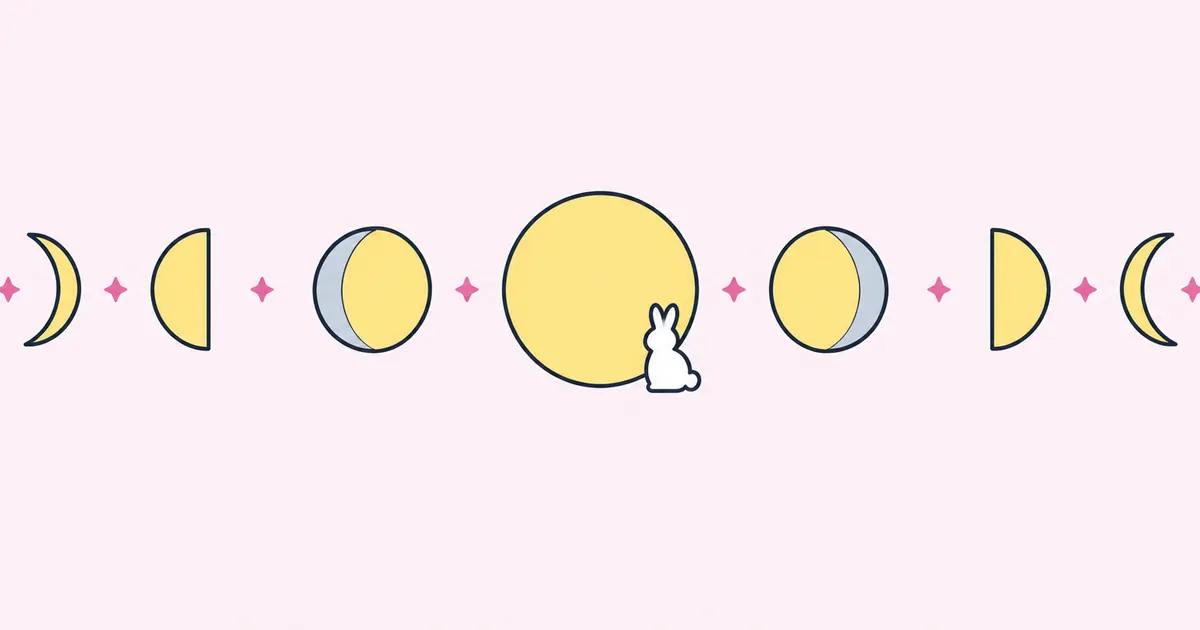
The eight phase emoji follow the moon's cycle: 🌑 new moon, 🌒 waxing crescent, 🌓 first quarter, 🌔 waxing gibbous, 🌕 full moon, 🌖 waning gibbous, 🌗 last quarter and 🌘 waning crescent. Writing them in order is a common way to show time passing, a loading bar, or a change that is still underway.
🌙 is the crescent people reach for when they mean night: good night, late-night study, a night owl, dark mode. In Unicode's emoji-test.txt, 🌙, 🌑, 🌓, 🌔 and 🌕 are Emoji 0.6, the oldest group, and 🌒, 🌖, 🌗 and 🌘 are Emoji 1.0, so none of them is a recent addition.
New moon
The dark start of the cycle, with no face. Often used for darkness, a fresh start, or simply the night sky. Emoji 0.6.
Waxing crescent moon
A thin sliver growing toward full. Second step in a phase row. Emoji 1.0.
First quarter moon
Half lit, still growing. Handy as a "halfway there" marker. Emoji 0.6.
Waxing gibbous moon
Almost full. The step right before 🌕 in a phase row. Emoji 0.6.
Full moon
The real full moon, or a Mid-Autumn and Chuseok greeting. No face, so no hidden tone. Emoji 0.6.
Waning gibbous moon
Just past full and starting to shrink. Emoji 1.0.
Last quarter moon
Half lit again, now shrinking. Emoji 1.0.
Waning crescent moon
The last sliver before the cycle starts over. Emoji 1.0.
Crescent moon
The moon people reach for when they mean night: good night, late-night study, a night owl, dark mode. Emoji 0.6.
Full phase row
All eight phases in order. Used for time passing, a loading bar, or a change still in progress.
Full moon, mooncakes and moon viewing
Around the Mid-Autumn Festival, 🌕 turns into a greeting. Chinese and Taiwanese messages often pair it with 🥮 and 🐇 for the moon rabbit, and Korean messages use the full moon for Chuseok; CLDR's Korean name for 🌕 is 보름달, the everyday word for a full moon. 🎑 is Japan's tsukimi, and its Japanese CLDR keywords include pampas grass, dumplings and the fifteenth night.
None of these readings is official. Unicode only names the characters; the festival uses are habits, and 🌕 on its own can simply mean the moon in the sky.
Moon cake
The Mid-Autumn pastry; CLDR's Traditional Chinese keywords for it include 中秋 (Mid-Autumn). Emoji 11.0.
Moon viewing ceremony
Japan's tsukimi: CLDR's Japanese keywords list pampas grass, dumplings and the fifteenth night. Emoji 0.6.
Which moon to send, and when to skip it
- Teasing a close friend: 🌚 works, and 🌚🌚🌚 when they are clearly hiding something.
- A boss, a client or someone you just met: skip 🌚, because the side-eye can read as judgement. 🌙 or 🌕 is safer if you want a moon at all.
- Saying good night: 🌙 on its own, or 🌜 and 🌛 around the words.
- Mid-Autumn or Chuseok greetings: 🌕 with 🥮 or 🐇.
- When tone matters: 🌚 looks different on Apple, Google and Samsung, so add a word or two instead of letting the face do all the talking.
Further reading
More faces with a second meaning, such as 💀 and 🫠, are in the internet slang explainer, and the Japanese article covers emoji that started out in Japan. To copy any other emoji, the full list is searchable by name.
The illustrations on this page are AI-generated. They are not emoji artwork from any platform.