Heart Emoji Meanings: What Each Color Says and Who to Send It To
The Unicode Standard names the colors and says nothing about what they mean. The meanings come from people: fandoms, sports teams, Snapchat's friend list, and, for Chinese readers, the old rule that red is for celebrations and white is for funerals.
Published
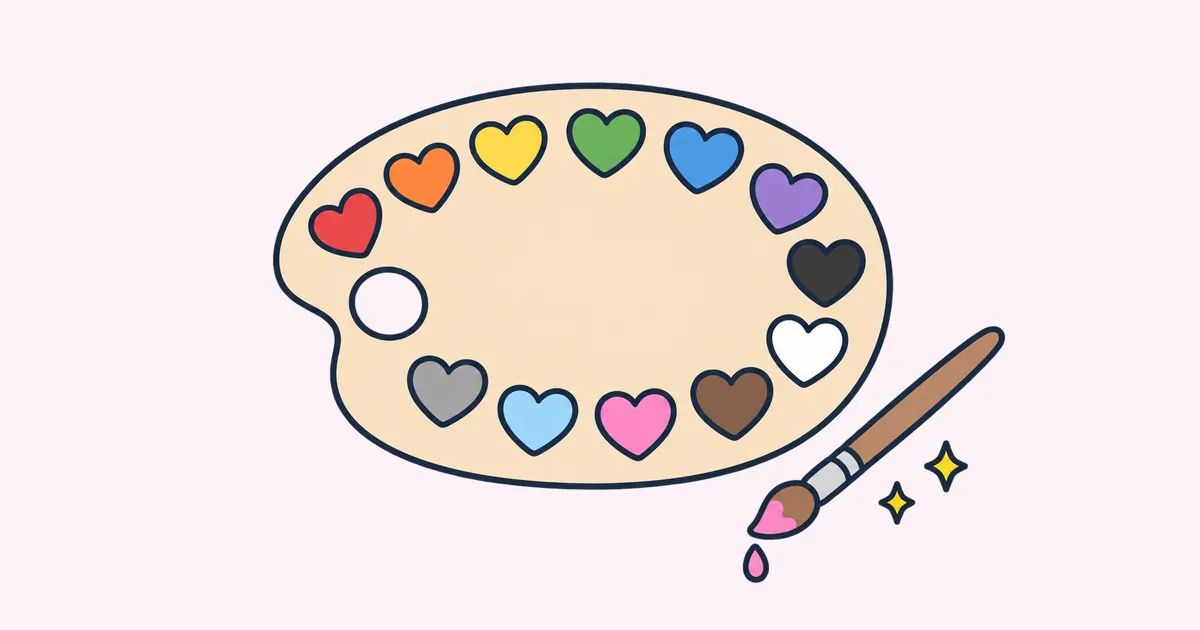
Heart colors have no official meaning. The Unicode Standard gives each heart a color name (🩶 is literally GREY HEART) and stops there; its own FAQ warns that a character's name may not cover everything an emoji means, and can even mislead. The meanings people talk about are habits that grew up around each color, and they shift with who sends it, in which app, and where it lands.
The short version:
- ❤️ is love at full strength. It works for romance, family, thanks and support, and it carries the most weight of any heart.
- 💛 and 🧡 are the friendly end: warm and close, without the declaration a red heart can imply. On Snapchat, 💛 also means you are each other's #1 best friend.
- Other colors often mean "I like something that is this color": a team, a band, a country, a season. In K-pop circles, 💜 means BTS.
- 🖤 and 🤍 can be a style or a sign of grief. For Chinese readers white is the funeral color and 🖤's Chinese name means wicked, so keep both away from congratulations.
- 🩷, 🩵 and 🩶 only arrived in 2022. An older phone may show an empty box instead.
Below, the hearts are grouped by color, each with a one-tap copy card, followed by the places where the same heart reads differently and a guide to picking one for a particular person.
The rainbow six: ❤️ 🧡 💛 💚 💙 💜
❤️ is the reference point for the rest. In the Unicode Consortium's ranking of emoji by use (2019 data) it comes second, behind only 😂. Its official name is HEAVY BLACK HEART: the character entered Unicode in the early 1990s as a black-and-white symbol, and "black" meant solid, not the color. Because it is the heart people use to say "I love you", it also weighs the most when sent to someone you barely know.
🧡 came much later, in Emoji 5.0 (2017). Its proposer, Paul D. Hunt, pointed out that people who wanted to spell out a rainbow in hearts had no orange to do it with, and used a 🎃 or a 🍊 in its place. It and 💛 sit at the warm, friendly end. Dictionary.com describes yellow as the heart for liking and friendship, handy wherever a red heart "may seem a bit much", and Snapchat made 💛 its marker for mutual best friends, of which more below.
For 💚, 💙 and 💜 a common reading is "I like something that is this color", which is how both Emojipedia and Dictionary.com describe them. 💚 goes with nature, environmental causes and anything Irish, and now and then with envy. 💙 is the heart brands reach for when red would read as romance. 💜 is the heart of BTS fans, and in the United States it can also recall the Purple Heart, the military decoration for service members wounded or killed in action.
Red heart
Love at full strength: romance, family, thanks, support. This card copies it with U+FE0F, so it shows red, not as a black text heart.
Orange heart
Warm and a notch lighter than red: support, close friends, autumn, orange team colors. Emoji 5.0 (2017).
Yellow heart
Friendship and happiness, for when a red heart would be a bit much. On Snapchat it marks mutual #1 best friends.
Green heart
Nature, the environment, all things Irish, green team colors; now and then, envy.
Blue heart
The neutral one: brands use it when red would read as romance. Also blue team colors.
Purple heart
Above all, BTS and its fans ("I purple you"). In the US it can also recall the Purple Heart medal.
Rainbow row
Six hearts in spectrum order. Before the orange heart existed the row had a gap, and people filled it with a jack-o'-lantern.
Black, white and brown: 🖤 🤍 🤎
🖤 arrived in Emoji 3.0 (2016). Emojipedia says it can carry morbidity, sorrow or dark humor but is still used mostly for love; Dictionary.com pictures a rainy day indoors, feeling misunderstood. Chinese adds a layer English lacks. Its Traditional Chinese name in Unicode's CLDR data, which this site's emoji list uses, is 黑心, "black heart", a word that in Chinese means wicked: Taiwan's Ministry of Education dictionary defines it as sinister and cruel, and CLDR's Chinese keywords for 🖤 include 邪惡, "evil".
🤍 and 🤎 both came in Emoji 12.0 (2019). 🤍 has the widest spread of readings: plain affection on one side, and on the other a common heart for mourning, which Emojipedia also links to heaven, angels and white wedding dresses. A Chinese custom covered below makes that split sharper. 🤎 carries less baggage: mostly a liking for brown things, and in English it also turns up often in conversations about racial identity.
Black heart
Dark humor, sorrow, a moody black look, or plain love. Its Chinese name, 黑心, also means wicked. Emoji 3.0 (2016).
White heart
Clean, simple affection, and often grief. White is the funeral color in Chinese custom. Emoji 12.0 (2019).
Brown heart
A liking for brown things; in English it also turns up in talk about racial identity. Emoji 12.0 (2019).
Pink, light blue and grey: 🩷 🩵 🩶 filled the gaps in 2022
🩷, 🩵 and 🩶 are Emoji 15.0, and the reasoning behind them is on file. In 2021 the Unicode Emoji Subcommittee submitted a strategy paper, written by Jennifer Daniel on its behalf. It notes that hearts are among the most used emoji, that people line up colored hearts to stand for a country, team or identity with no emoji of its own, and that colored hearts are the most common emoji outside conversations, in places such as Twitter bios.
The paper checked the existing hearts against the linguistics of basic color terms and found only pink and grey missing. Light blue was added on top, because some languages, Korean and Russian among them, split blue into two basic words where English has one. The three proposals that followed spell out the uses they expected: 🩷 for cute, affectionate messages; 🩶 for silver and grey sports teams, and even for people proudly letting their hair go grey early; 🩵 for the sky blue on flags such as Argentina's.
One naming quirk is worth knowing if you write to Chinese speakers. This site's emoji list, built from CLDR, shows 🩶 as 灰色愛心, "grey heart", in Traditional Chinese. CLDR's Simplified Chinese name for it is 灰心, and 灰心 is an everyday word for feeling discouraged or disheartened. The proposal had silver and grey hair in mind, a long way from what that name suggests.
Pink heart
Cute, sweet, affectionate: the plain pink heart people asked for for years. Emoji 15.0 (2022).
Light blue heart
Sky blue things: pale blue team colors, flags like Argentina's. Korean and Russian name this blue separately. Emoji 15.0 (2022).
Grey heart
Silver and grey: team colors, grey hair worn proudly. Its Simplified Chinese name reads 灰心, "disheartened". Emoji 15.0 (2022).
Where the same heart means something else
Some apps give hearts meanings of their own. Snapchat's help page spells its version out: next to a friend's name, 💛 means you are each other's #1 best friend, ❤️ means that has held for two weeks in a row, and 💕 means it has held for two months. The app sets these from how you both use it, so a heart there says how often you snap each other, not which color anyone picked.
Among K-pop fans, 💜 belongs to BTS. Member V coined 보라해 (borahae, "I purple you"), which the Korea Herald glosses as "I will trust and love you for a long time", and the fandom took purple as its color; Dictionary.com dates it to a concert in 2016. The Unicode proposal for the light blue heart even credits BTS fans with making 💜 the third most used heart on Twitter.
The finger heart is the other Korean export, and the one to watch. The proposal for 🫰 called it an extremely popular "finger heart" in Korea, then listed its other readings: money, something too expensive, a debt owed. Sent to someone who does not follow K-pop, it may read as "pay up". For a hand heart that is harder to misread, use 🫶; its proposers, Telefónica Germany among them, pitched it as a symbol against online bullying.
Countries and teams use hearts for their colors, too. The Unicode proposals give two examples: Australians use 💚💛, the green and gold, rather than the blue, red and white of the flag, and the national color of the Netherlands is 🧡. The original orange heart proposal, too, noted that orange is a popular color for sports teams worldwide.
In Chinese-speaking places, watch red against white. Red belongs to happy occasions and white to funerals: the Ministry of Education dictionary defines 紅白事, "red and white affairs", as happy events and funerals, and explains 紅包, the red envelope, as money given at celebrations, named for its red wrapping. So under a wedding photo or a new baby in a Taiwanese family group chat, ❤️ and 🧡 are the safe picks; keep 🤍 and 🖤 for condolences.
Finger heart
A finger heart in Korea; elsewhere the same gesture can mean money, "too pricey" or "pay up". Emoji 14.0 (2021).
Heart hands
Two hands shaped into a heart, hard to misread. It was proposed as a sign against online bullying. Emoji 14.0 (2021).
Two hearts
Two pink hearts. On Snapchat, #1 best friends with each other for two months in a row.
Why your red heart turned black, or into a box
❤️ is really two characters: ❤ (U+2764) followed by U+FE0F, a variation selector that asks for the colorful emoji style. The standard's default for ❤ is the black-and-white text style, so without U+FE0F some systems draw it as a small black symbol. Nothing is broken. The ❤️ card in this article copies the full version with U+FE0F.
The colors themselves are not fixed either. Unicode names each heart and leaves the drawing to each platform, so shades differ from phone to phone. Two extreme cases are on record: the pink heart proposal notes that as recently as 2017, Android 7.0 drew the red heart pink, and Emojipedia records Android 4.4 drawing 💛 as a pink, hairy heart.
New hearts need new software. 🩷, 🩵 and 🩶 are Emoji 15.0; Apple put them on the keyboard with iOS 16.4 in March 2023, and a device whose emoji font is older shows a blank box. ❤️🔥 (heart on fire) and ❤️🩹 (mending heart) fail differently: they are ZWJ sequences from Emoji 13.1 (2020), so a device that does not know them shows the parts, ❤️ next to 🔥 or ❤️ next to 🩹.
Heart on fire
Burning love, passion. A ZWJ sequence, so an older phone shows a heart and a flame side by side. Emoji 13.1 (2020).
Mending heart
Healing, getting better, get well soon. Also a ZWJ sequence. Emoji 13.1 (2020).
Which heart is safe to send to whom
The color is a hint; the relationship and the occasion decide the meaning. If you are unsure, these defaults rarely go wrong:
- A partner, or someone you are flirting with: ❤️ says it most plainly. 🩷 or 🧡 say it more lightly.
- Friends, classmates, family: 💛 or 🧡, which are less likely to read as a confession.
- Colleagues, clients, a brand's social account: 💙, or your team's own color.
- Chinese-speaking relatives and happy news: ❤️ or 🧡. Leave out 🤍 and 🖤.
- Condolences: 🤍 is a common choice. For get-well wishes, ❤️🩹: its CLDR keywords are literally healthier, improving and recovering.
- Not sure how new their phone is: stick to the hearts that have been emoji since 2010 (❤️ 💛 💚 💙 💜) and skip 🩷 🩵 🩶 and ❤️🔥.
- Someone who does not follow K-pop: send the hand heart 🫶, not 🫰.
And when a color still makes no sense, ask. The same 🩶 might be a team's silver jersey or just someone who likes muted colors, and "does that color mean something?" gets a better answer than any chart.
Further reading
Why the same emoji looks different on every phone, and what the empty box really means, is the subject of the other explainer here. To copy a heart, the emoji list is searchable by color name.
The illustrations on this page are AI-generated. They are not emoji artwork from any platform.