Hand Emoji Meanings Around the World: Where 👌 👍 ✌️ Can Offend
The same hand can say something else abroad. 👌 can mean money, zero or an insult, ✌️ with the palm turned in is rude in Britain, and 🤘 in Italy tells someone their partner is cheating. Here is what 14 of the hand emoji mean around the world.
Published
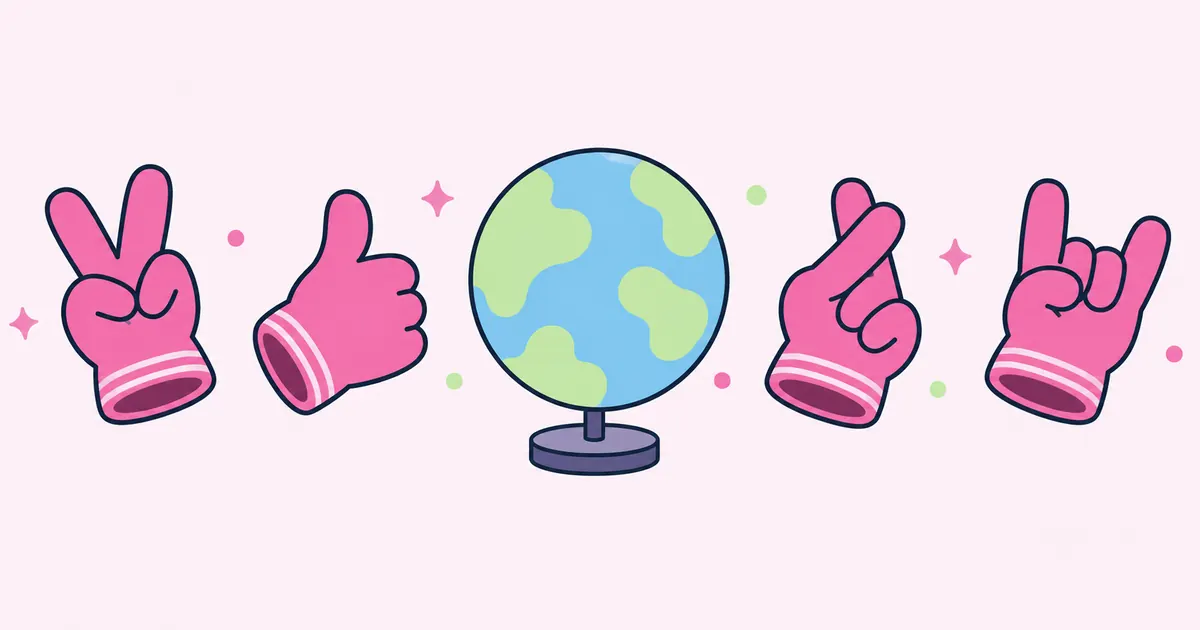
Hand emoji meanings depend less on the emoji than on the person reading it. A gesture that means "great" in one country is a number in a second and an insult in a third, and an emoji is that same gesture dropped into a chat: the reader still sees it through their own culture. Here is the short version first, then each hand in turn. Every example copies with one tap.
- 👌 is OK in English and "I'm OK" to divers, but money in Japan, zero in the south of France and an insult in Brazil and Turkey.
- 👍 is approval almost everywhere, yet traditionally an insult in Iran, the number one in Germany and "going up" underwater.
- ✌️ with the palm out means victory or peace and is the default photo pose in East Asia; with the palm facing you, it is rude in Britain.
- 🤘 is heavy metal and the University of Texas, but pointed at someone in Italy it says their partner is cheating on them.
- 🙏 is thanks, please or sorry in Japan, namaste in India and the wai in Thailand. The readings differ; all of them are friendly.
What does 👌 mean? OK, zero, money or an insult
Unicode calls 👌 "OK hand", and in English-speaking countries that is all it means: fine, sounds good. Divers use it as a formal signal. In the Recreational Scuba Training Council's standard list of hand signals, a circle of thumb and forefinger with the other three fingers extended means "Are you OK?" or "OK!". A thumbs up means something else entirely down there, as the next section explains.
Outside the English-speaking world the circle is read as something else. A 1996 New York Times piece, excerpting Roger Axtell's guide to gestures abroad, noted that in France, particularly the south, it means "zero" or "worthless", and that in Japan it stands for money; a Japanese gesture dictionary records the money sense too. In Brazil and Turkey it is a crude insult, which the Guardian's list of travel faux pas flags for anyone going diving off the Brazilian coast. Unicode's own keyword lists reflect this: the Brazilian Portuguese keywords for 👌 include "rude", and the Korean ones include the word for money.
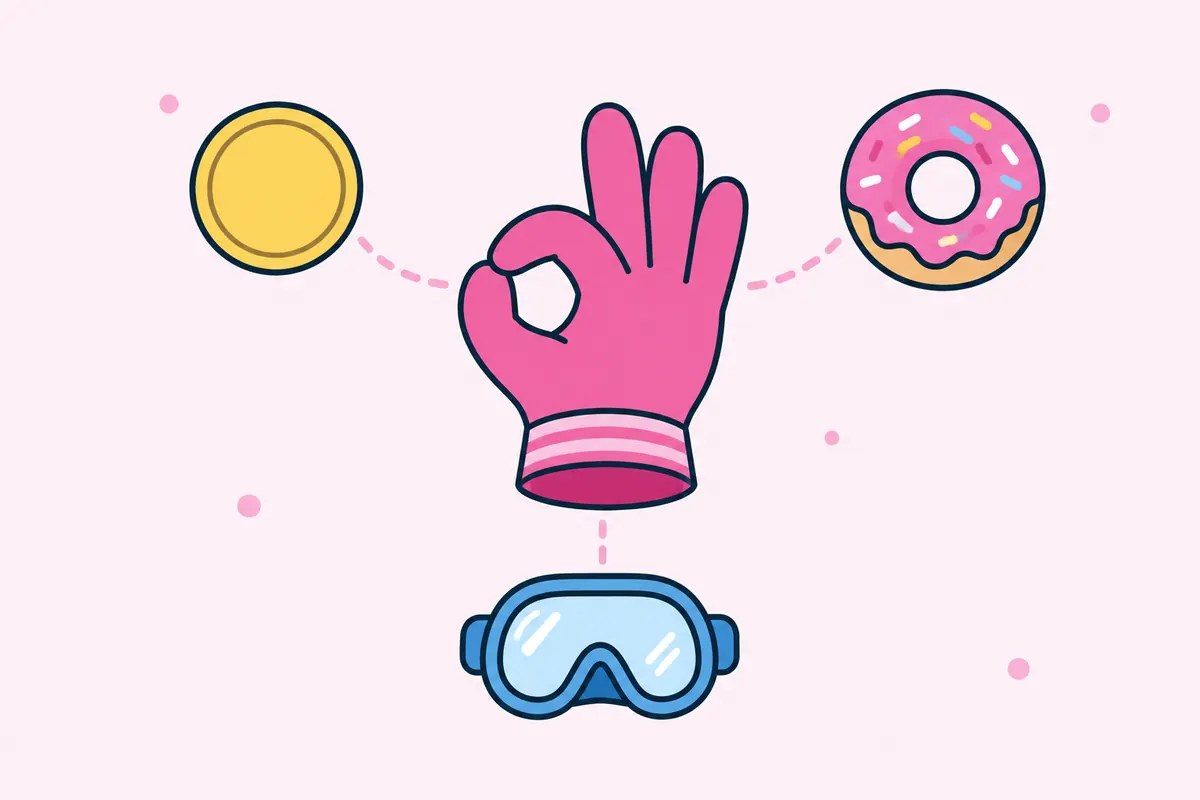
OK hand
OK in English-speaking countries and "I'm OK" to divers; money in Japan, zero in the south of France, an insult in Brazil and Turkey.
What does 👍 mean? Approval, mostly
👍 is "thumbs up", and most of the world reads it as approval. The exceptions are real, though. The Guardian put a thumbs up in Iran at the top of its 2007 list of travel faux pas, calling it an unquestioned insult there. In 1996, the opening session of Bangladesh's new parliament descended into chaos when the opposition accused a minister of flashing one and demanded an apology; Reuters reported at the time that the gesture is considered a grave insult in Bangladesh.
It also counts and gives directions. Germans count from the thumb, so a raised thumb is one: a 2009 study in the Journal of Cross-Cultural Psychology found that, of the German and Canadian participants, only the Germans used the thumb for the number one. Underwater, the diving standard defines a raised thumb as "go up" and 👎 as "go down"; OK is the 👌 circle. And in chats a lone 👍 can come across as curt, even passive aggressive.
In one country it has even counted as a signature. In 2023 a Saskatchewan court held that a farm which replied 👍 to a photo of a contract and the message "Please confirm flax contract" had accepted that contract, and awarded the buyer about CA$82,000. The Court of Appeal for Saskatchewan upheld the ruling in 2024, and in July 2025 the Supreme Court of Canada declined to hear a further appeal.
Thumbs up
Approval almost everywhere, but traditionally an insult in Iran, the number one in Germany and "going up" underwater.
Thumbs down
Disapproval on land. Underwater it is the standard signal for "go down".
Is ✌️ rude? It depends on your palm
✌️ is "victory hand". With the palm facing out it means victory or peace, and Unicode's English keywords list both. Turn the hand around, palm toward yourself and the back of the hand to the other person, and in Britain it becomes an insult: the Oxford Advanced Learner's Dictionary files that version under "two fingers", a British English sign "used as a way of being rude to other people".
In Taiwan, Japan and South Korea, ✌️ is simply what you do in a photo. In Taiwan it comes with a cheerful 耶 (yay), a word Unicode lists among its Traditional Chinese keywords, and in Japan it is called pīsu, peace. TIME traced the Japanese habit in 2014 to two popular stories: the American figure skater Janet Lynn, who flashed the sign constantly on media tours after the 1972 Sapporo Olympics, and the singer Jun Inoue, who is said to have made it on the spot while filming a Konica camera commercial. The same report found it only became widespread in the late 1980s, and that it spread with Japanese pop culture to mainland China, Hong Kong, Taiwan and South Korea. In Japanese and Korean, ✌️ is also scissors in rock paper scissors.
Victory hand
Victory or peace with the palm out, and the default photo pose in East Asia. Palm facing you, it is rude in Britain.
🤘 and 🤟: one thumb apart
🤘 is "sign of the horns": index and little finger up, the rest folded down. Most people know it from heavy metal. In Texas it is also Hook 'em Horns, the University of Texas hand signal, meant to look like the head of a longhorn. The university's own account says head cheerleader Harley Clark introduced it at a pep rally in November 1955, and that the dean of students confronted him afterwards: "do you know what that hand sign means in Sicily?"
The dean most likely had the corna, the horns, in mind. An Italian dictionary defines fare le corna, making the horns, as a gesture that either wards off bad luck or insults someone. The insult is the one aimed at a person, and it says their partner is being unfaithful, because in Italian to put horns on your spouse means to cheat on them. Axtell's guide adds that in Brazil and Venezuela the same hand is a good-luck sign.
🤟 adds the thumb, and the thumb changes everything. It is the "I love you" sign from American Sign Language, the letters I, L and Y combined in one hand, and Unicode names it "love-you gesture". If you mean affection, check that the thumb is out. Without it you are sending metal, or in Italy, trouble.
Sign of the horns
Heavy metal and the University of Texas. Aimed at someone in Italy, it says their partner is unfaithful. Emoji 1.0 (2015).
Love-you gesture
"I love you" in American Sign Language: I, L and Y in one hand. The extended thumb is what makes it love. Emoji 5.0 (2017).
🤞 🤙 🤌: same shape, different countries
🤞 is "crossed fingers", the hand behind "cross your fingers" and "keep your fingers crossed". The Oxford Advanced Learner's Dictionary defines crossing your fingers as hoping that your plans will be successful. German speakers wish each other luck differently: the phrase the Duden dictionary gives is die Daumen drücken, to press your thumbs.
🤙 is "call me hand", thumb and little finger out like a phone receiver. In Hawaii it is the shaka, a way of showing aloha and saying hang loose, and in June 2024 the governor signed a bill making it the state's official hand gesture. The usual origin story credits Hamana Kalili, a sugar mill worker in Laie who lost three fingers in an accident, but that is local lore rather than record. Chinese speakers see a third meaning: in Chinese hand counting, thumb and little finger up is six.
🤌 is "pinched fingers", added in Emoji 13.0 in 2020. It is the Italian gesture for "what do you want?" or "what are you on about?", and Unicode's Italian keywords are exactly that: che vuoi, ma che dici. In Chinese hand counting, fingertips pinched together much like this are one common way to show seven.
Crossed fingers
Hoping for luck, as in "fingers crossed". German speakers press their thumbs instead. Emoji 3.0 (2016).
Call me hand
A phone receiver, Hawaii's shaka, and six in Chinese hand counting. Emoji 3.0 (2016).
Pinched fingers
Italy's "what do you want?", and close to one way of showing seven in Chinese hand counting. Emoji 13.0 (2020).
🙏 and 🫰: how Asia reads them
🙏 is "folded hands". Unicode keeps keyword lists for dozens of languages, and they show how differently it is read. The Japanese one has arigatō (thank you), onegai (please) and gomen nasai (sorry); the Hindi one has namaste; the Thai one has wai, the pressed-palms greeting; the English one has pray and please. All of those are friendly, and the only question is whether you are thanking, asking or praying, which the rest of the message has to answer. Whether it was ever a high five is covered in the other article.
🫰 arrived in Emoji 14.0 in 2021 as "hand with index finger and thumb crossed". Its Korean keywords call it a finger heart, the tiny heart made by crossing thumb and forefinger, and the Portuguese list even includes k-pop. The English and Korean lists also include money and expensive, though, so context decides whether you are sending love or complaining about a price.
Folded hands
Thank you, please or sorry in Japan, namaste in India, the wai in Thailand, and prayer for many.
Hand with index finger and thumb crossed
The Korean finger heart, though its keywords also say money and expensive. Emoji 14.0 (2021).
👋 🖐️ 🫵: waving is safe, pushing and pointing are not
👋 is about as safe as a hand emoji gets: in most of Unicode's keyword lists it means both hello and goodbye, from Japanese baibai to Korean annyeong. What to watch is an open palm pushed toward someone. In Greece that is the moutza (μούντζα), which the Dictionary of Standard Modern Greek defines as an insulting gesture made by thrusting the open palm toward someone; its etymology traces the sense to smearing the face of an offender paraded in public with a palm dipped in soot. 🖐️ on its own is fine, but it is not the emoji to end an argument with a Greek friend.
🫵, added in Emoji 14.0, is "index pointing at the viewer", and online it mostly just means "you". Pointing at people with a finger is impolite in many places, though. The same Guardian list notes that in Malaysia it is considered rude, and that people there point with a closed fist, the thumb on top showing the direction.
Waving hand
Hello and goodbye in nearly every language. The safest hand on this page.
Hand with fingers splayed
Stop, or five. Pushed toward someone in Greece, it is the moutza, an insult.
Index pointing at the viewer
"You". Pointing at people is impolite in many places; in Malaysia people point with the thumb. Emoji 14.0 (2021).
Before you send a hand emoji abroad
An emoji is not a gesture. It has no movement and no facial expression, and you cannot choose which way the palm faces, so the reader fills all of that in from their own habits. A few rules of thumb for chats that cross borders:
- With friends in Brazil or Turkey, write "OK" rather than sending 👌.
- With contacts in Iran, especially more traditional ones, do not use 👍 as a read receipt.
- Posing for a ✌️ photo in Britain, keep the palm facing out.
- With Italian friends, save 🤘 for when you are talking about music.
- At work, 👍 can be read as agreement, and in Canada it has counted as accepting a contract. When it matters, reply in words.
If you came for the emoji themselves, the Emoji list below finds any of them by name, and its hand emoji come in every skin tone. What single emoji such as 💀 and 🙏 mean online is covered in the other article.
The illustrations on this page are AI-generated. They are not emoji artwork from any platform.