Japanese vs Western Emoticons: Why ^_^ Smiles With the Eyes and :) With the Mouth
^_^ and :) both smile, but with different parts of the face. In a 2007 study, faces whose eyes looked happier than their mouths seemed mildly happy to Japanese students and sad to American ones.
Published
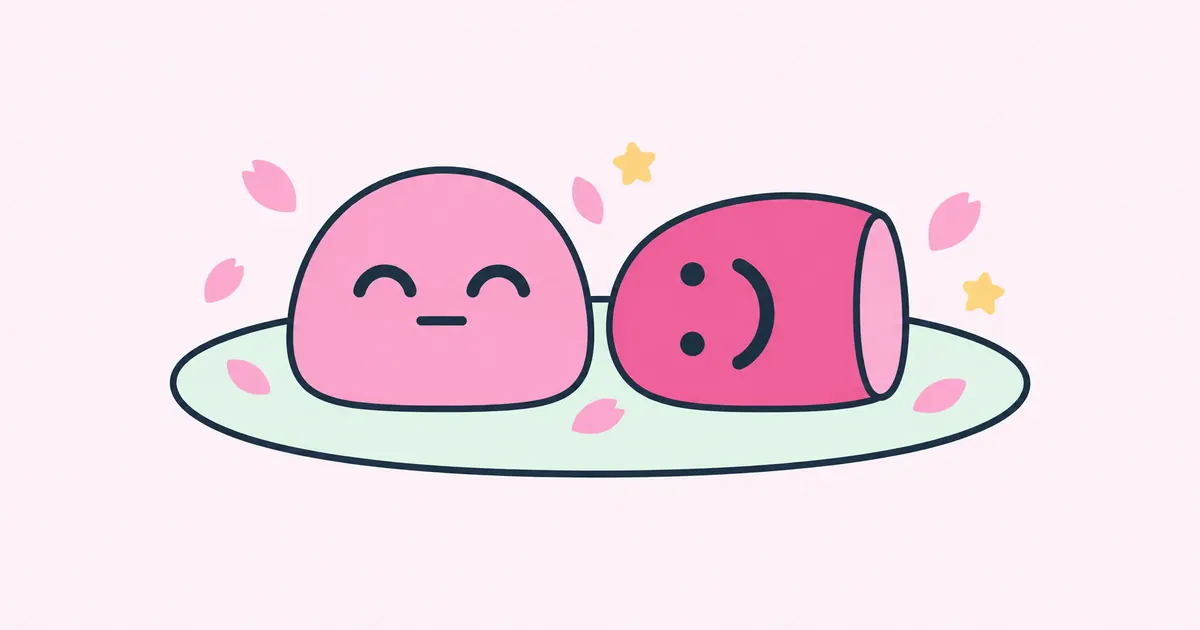
^_^ is a smile. The two carets are eyes squeezed into happy arcs, the underscore is a mouth, and it means pleased, friendly, no hard feelings. It says the same thing as :), just with a different part of the face: Japanese-style emoticons, or kaomoji, stand upright and change their expression through the eyes, while Western emoticons lie on their side and change it through the mouth. That split is not only a keyboard habit. Psychologists have tested it, and it shows up in how people read real faces too.
- ^_^ means happy, friendly or pleased. ^^ is the same smile without a mouth, and ^_^; adds a drop of cold sweat for an awkward, sheepish grin.
- Japanese-style emoticons change the eyes: ^_^ smiles, T_T cries, -_- is unimpressed. Western ones change the mouth: :) smiles, :( is sad, :D laughs.
- In a 2007 study, faces whose eyes looked happier than their mouths seemed mildly happy to Japanese students and sad to American ones. A 2020 comparison of Japanese and Dutch students pointed the same way.
- Emoji draw both. 😊 smiles with its eyes and its mouth, 🙂 only with its mouth, so when you mean it, 😊 is the safer pick.
Smiling eyes
The basic Japanese-style smile: each ^ is an eye curved shut with laughter, the underscore a mouth. Happy, friendly, and it softens the line it ends.
Classic smiley
The basic Western smile: a colon for eyes and a bracket for the mouth, read with your head tilted. The mouth does all the work; flip the bracket and it is :( instead.
What does ^_^ mean? The smile is in the eyes
Read ^_^ piece by piece: each ^ is an eye curved shut, the way eyes narrow in a real laugh, and the _ in the middle is the mouth. You can see it is a face without tilting your head, but the mouth has to stay flat, because nothing on a keyboard curls upward. When The New York Times introduced Japan's kao maaku, or face marks, in 1996, it made exactly that point: the Japanese smiley is easier to recognize as a face, yet harder to read without context, because its mouth cannot turn up. What is left to change is the eyes, so smiling, crying and staring blankly all happen there.
The family has a few regular variants. ^^ drops the mouth completely and keeps only the eyes; a large study of early Twitter even defined the upright style by its eyes, with no mouth by default. ^_^; adds a semicolon, which is a bead of cold sweat: embarrassed, apologetic, a little out of your depth. The same study found the sweat-drop variants especially popular in Japan and South Korea; they are thought to come from anime, where characters sprout a big sweat drop in awkward moments. The 1996 Times piece reported that, after the basic smile, the cold-sweat face was the most popular mark in Japan. \(^o^)/ opens the mouth and throws both arms up: banzai, a cheer.
Eyes only
Drop the mouth and the eyes still carry the smile. In a study of early Twitter it was the most used upright emoticon, and South Korea used the upright style most.
Smile with a sweat drop
The semicolon is a bead of cold sweat: an awkward, sheepish or slightly lost smile. Usually traced to the big sweat drops of Japanese anime.
Banzai cheer
Mouth open and both arms up in a banzai cheer. The New York Times already described this kind of face in its 1996 piece on Japanese emoticons.
Why :) is read sideways: two smileys, two origins
The sideways one came first. On September 19, 1982, Scott Fahlman proposed :-) on a Carnegie Mellon computer science bulletin board as a marker for jokes, adding "Read it sideways." In the same post he suggested :-( for things that were not jokes, though it soon came to mean displeasure instead. The post was lost for years and only recovered from old backup tapes in 2002, which is how the exact date is known.
The upright one is usually traced to Japan, almost four years later. On June 20, 1986, Yasushi Wakabayashi signed off a post on ASCII Net, a Japanese online service, with (^_^). On his own website he recalls that hardly anyone recognized it as a face at first; it caught on after he put it in his chat handle and others copied him, and from there it spread to other networks. He also writes that he did not know the Western smiley at the time, so in his account the two arose independently. The confusion ran the other way too: a Japanese network pioneer told The New York Times that he had to keep explaining to Japanese correspondents, "If you tilt your head, you will see the face."
Smiley with a nose
The version Scott Fahlman proposed in 1982, nose included, as a marker for posts that were jokes.
Frown with a nose
Fahlman first suggested it for posts that were NOT jokes. It soon came to mean displeasure instead.
Eyes in Japan, mouth in the US: what the research found
A study often cited on this point was published in 2007 in the Journal of Experimental Social Psychology by Masaki Yuki of Hokkaido University, with William Maddux and Takahiko Masuda. They showed 95 Hokkaido University students and 118 Ohio State University students six simple illustrated faces, each pairing eyes and a mouth that were happy, neutral or sad in different combinations, and asked them to rate each one from 1 (extremely sad) to 9 (extremely happy), with 5 as neutral.
The split was sharp. For faces whose eyes were happier than their mouths, Japanese students averaged 5.81 and American students 2.99. For faces whose mouths were happier than their eyes, the Americans rated higher, 5.54 against 4.78. A second study, which pasted eyes and mouths from photos of real faces into new combinations, pointed the same way. The authors' explanation is that the muscles around the eyes are harder to control on purpose than the ones around the mouth, which is why a genuine smile, the so-called Duchenne smile, reaches the eyes. In their account, where holding emotions in is the norm, as in Japan, the eyes are the more honest signal; where showing them openly is the norm, as in the US, the mouth, the most expressive part of the face, becomes the main cue.
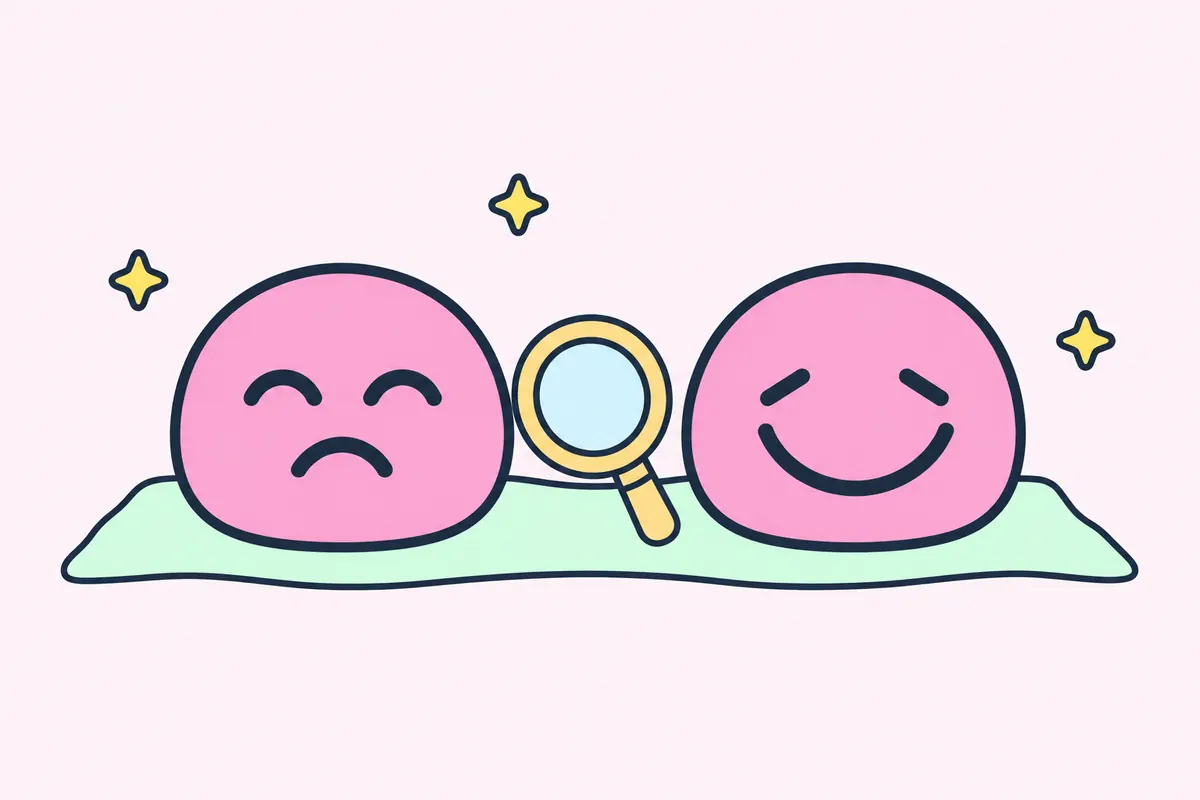
Later work points the same direction. In 2020 a team from Tokyo Woman's Christian University and Leiden University used the same illustrated faces with 50 Japanese and 42 Dutch students: the Japanese again weighted the eyes, while the Dutch leaned toward the mouth, though that half of the difference was only marginally significant. A University of Glasgow team tracked the gaze of 13 East Asian and 13 Western observers in 2009 and found that the Westerners spread their fixations across the face while the East Asians kept returning to the eyes. In a 2012 paper in PNAS the same group noted that East Asian observers represent the intensity of an emotion with the eyes, as the region's emoticons do: (^.^) is happy and (>.<) is angry.
These are group averages, not rules: plenty of Japanese readers watch mouths and plenty of Americans watch eyes. Reading emoticons at all is also learned. A 2017 study in Cameroon and Tanzania, with participants who rarely see emoticons, found that they judged photos of real faces much as Japanese participants did but could hardly read any emotion from symbol faces such as ☺. Its conclusion: ☺ does not necessarily look smiling to everyone.
Streaming tears
Each T is an eye with a tear running straight down from it. Crying, or very sad.
Flat stare
Two flat lines for eyes: unimpressed, speechless, done with this.
One eye wider
One eye opened wider than the other: confused and surprised at once, as in wait, what?
Eyes squeezed shut
Eyes screwed shut: frustration, embarrassment, bracing for something, and for some writers anger. Context decides.
Who types ^^ and who types :)? 1.1 billion tweets
Researchers from KAIST and elsewhere looked at Twitter from 2006 to 2009, 1.1 billion tweets from 10 million users in 15 countries, and published the results in 2013. English-speaking countries used the sideways style overwhelmingly. South Korea used the upright style 74% of the time, and Japan used the two about equally. Indonesia and the Philippines, where English is widely used online, looked like the English-speaking countries, which the authors took as a sign that language matters more than geography; France and Germany had a noticeable share of upright users too. Everywhere, :) was the most common sideways face and ^^ the most common upright one, and :) alone appeared in 46 million tweets, more than any other.
Do not treat the line as a wall, though. Sideways faces use the eyes sometimes: ;) turns one eye into a wink, and in XD the X is a pair of eyes squeezed shut. Upright faces add mouths too, as in ^o^, a laugh with the mouth wide open. The difference is the default: sideways faces start from the mouth, upright ones from the eyes.
Wink
Proof the sideways style uses the eyes too: swap one eye for a semicolon and it winks. Only joking.
XD
A sideways laugh: X is a pair of eyes squeezed shut, D a wide-open mouth. Horizontal, yet half of it is in the eyes.
Emoji draw both the eyes and the mouth
Emoji are drawn rather than pieced together from punctuation, so they can show both features, and both readings ended up in one character set. The official Unicode names show how much the eyes matter: 😊 is SMILING FACE WITH SMILING EYES, and 😄 and 😁 carry SMILING EYES in their names as well. All three arrived in Unicode 6.0 in 2010, and the mapping file Unicode keeps matches each of them to emoji from Japanese mobile carriers. 🙂 came later, in Unicode 7.0 in 2014, as SLIGHTLY SMILING FACE: two dots for eyes and a gentle curve of a mouth, and the mapping file lists no carrier emoji for it.
Seen through the eyes-or-mouth lens, 🙂 is a neutral-eyes, happy-mouth face, the very type that Japanese students in the 2007 study rated as less happy than American students did. That study never tested 🙂 itself, so take this as a reading rather than a finding; still, Emojipedia notes that its tone can come across as patronizing, passive-aggressive or ironic. The Traditional Chinese name that Unicode's CLDR gives it is telling as well: 😊 is 微笑, a smile, while 🙂 is 呆呆笑, something like a vacant grin.
Several old kaomoji expressions have emoji counterparts. The cold sweat of ^_^; became 😅, whose formal Unicode name includes COLD SWEAT; the two streams of T_T look like the tears running straight down 😭; and the flat eyes of -_- are 😑, expressionless.
Smiling face with smiling eyes
Eyes and mouth smile together, with blushing cheeks. Its Unicode name says smiling eyes, and it entered the standard in 2010 from Japanese mobile carriers’ emoji.
Slightly smiling face
Only the mouth smiles; the eyes are two dots. Its tone can come across as patronizing, passive-aggressive or ironic rather than happy.
Grinning face with sweat
The emoji version of ^_^;: a grin with a drop of cold sweat, which is what its formal Unicode name says.
Loudly crying face
Two streams of tears running straight down, much like the two lines of T_T.
Expressionless face
Eyes and mouth are all flat lines: the emoji cousin of -_-.
Which face to send
- Genuinely happy: ^_^, ^^, 😊. With someone you do not know well, 😊, smiling with both eyes and mouth, is the safest.
- Laughing: XD, :D, 😄.
- Awkward or sheepish: ^_^;, 😅.
- Crying or very sad: T_T, ;_;, 😭.
- Unimpressed: -_-, 😑.
- Joking, do not take it seriously: ;).
A simple rule: the more the feeling matters, the more you want a face whose eyes and mouth agree. A mouth-only 🙂 or an eyes-only ^_^ is fine among friends, but with someone you do not know well, or someone from a different generation or culture, it can read as something else. How parents and younger people read 🙂 and 👍 differently is covered in another article here.
Find more faces on this site
This site keeps both styles: most categories have a Western tab and a Kaomoji tab, the English pages open on Western and the Chinese pages on kaomoji, and one tap on the tabs switches between them. ^_^ and ^^ are under Cute, the cold-sweat ^_^; under Embarrassed and T_T under Crying; the home page shows every category at once.
- Cute kaomoji and emoticons: ^_^, ^^ and other smiling eyes →
- Embarrassed kaomoji: ^^; and the cold-sweat faces →
- Crying kaomoji: T_T, ;_; and :'( →
- All kaomoji and emoticons, every category, one tap to copy →
- The full emoji list: find 😊 and 🙂 by name →
- Is the thumbs up emoji passive aggressive? Emoji across generations →
- What do kkkk, jajaja, www and 555 mean? How the world laughs online →
The illustrations on this page are AI-generated. They are not emoji artwork from any platform.