
Compound Interest Calculator
Model compound growth, recurring investing and your FIRE number
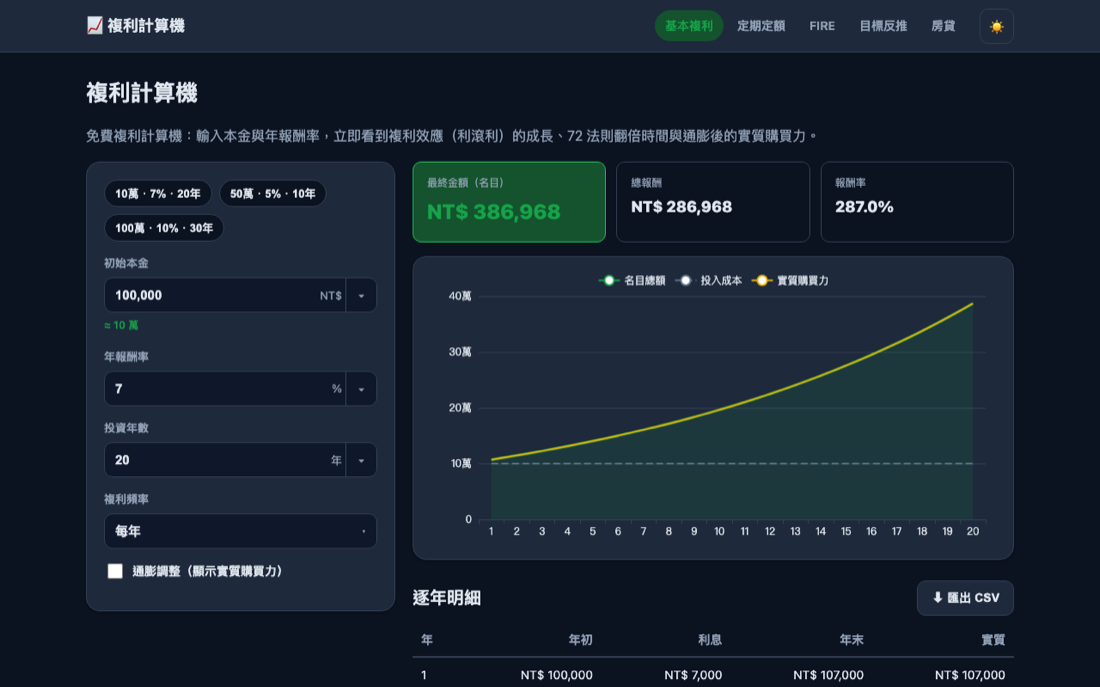 Tap the image to open the tool ↗
Compound growth is the most useful and the least intuitive part of long term planning. What drives it is not a high rate of return but a long runway. This page covers what the tool does, then explains compounding, recurring investing, FIRE and mortgage numbers so the results you get actually mean something.
Open the Compound Interest Calculator ↗
What this tool does
The calculator puts the five calculations people reach for most often on one site. Everything runs in your browser as you type, with no sign up and nothing to install:
- Compound interest: enter a starting amount, an annual rate and a number of years to get the final balance and the interest earned.
- Recurring investing: put in a fixed amount every month and see what it adds up to over time.
- FIRE: estimate the assets and the number of years you need for financial independence, using ideas such as the 4% rule.
- Goal back solving: start from the amount you want to have and work backwards to the monthly contribution it takes.
- Mortgage: enter the loan amount, the rate and the term to get the monthly payment and the total interest.
Every calculation comes with an interactive chart of the balance over time, a year by year table, and a CSV export so you can keep the numbers or take them into a spreadsheet.
Compound interest versus simple interest
Simple interest only pays on the amount you started with. Compound interest rolls each period's interest back into the balance, so the next period is calculated on a larger base. Interest starts earning interest.
An example makes the gap obvious. Say you start with NT$1,000,000 at a 7% annual return:
| Years | Simple interest | Compound interest | Difference |
|---|---|---|---|
| 10 | NT$1,700,000 | about NT$1,970,000 | NT$270,000 |
| 20 | NT$2,400,000 | about NT$3,870,000 | NT$1,470,000 |
| 30 | NT$3,100,000 | about NT$7,610,000 | NT$4,510,000 |
The gap does not grow in a straight line. Ten years apart is NT$270,000, thirty years apart is NT$4,510,000. The longer the runway, the steeper the curve gets, which is why starting early beats almost every other decision in a long term plan.
The rule of 72
When you want a rough answer without opening anything, divide 72 by the annual rate of return and you get the number of years it takes to double your money.
| Annual return | Roughly doubles in |
|---|---|
| 3% | 24 years |
| 6% | 12 years |
| 8% | 9 years |
| 12% | 6 years |
At 6% a year, money doubles in about 12 years (72 ÷ 6) and quadruples in about 24. It is a good sanity check. Use the calculator above when you need the real number.
Why recurring investing works
Not everyone has a lump sum to start with. Putting in a fixed amount every month turns ordinary cash flow into a long term position, and it spreads your entry across time, so the same amount buys more units when prices are low. Run it through the recurring investing mode and the total is usually much larger than people expect, even when the monthly amount is small.
FIRE and the 4% rule
FIRE, short for Financial Independence, Retire Early, comes down to one question: how much do you need before investment income can cover your life?
The most quoted answer is the 4% rule. If you withdraw 4% of your portfolio in the first year and adjust from there, historical backtests suggest the money has a good chance of lasting for decades. Turn that around and the target is roughly 25 times your annual spending, because 1 ÷ 4% = 25.
- Annual spending of NT$600,000 gives a target of about NT$15,000,000.
- Annual spending of NT$1,000,000 gives a target of about NT$25,000,000.
The FIRE mode ties the target, your current progress, your monthly contribution and an expected return together and estimates how many years are left.
The part people forget: real returns
The rate you type in is a nominal return, and inflation quietly eats into what that money can buy. What matters for planning is the real return, which is roughly the nominal return minus inflation.
With a 7% nominal return and 3% inflation, the real return is closer to 4%. The NT$7,610,000 in the table above looks impressive, but in today's purchasing power it is worth noticeably less. For long horizons, enter a conservative rate, or mentally subtract inflation before you read the result.
How to use it
- Pick the calculation you need at the top: compound interest, recurring investing, FIRE, goal back solving or mortgage.
- Fill in the amount, rate, years and other inputs on the left.
- The result, the growth chart and the yearly breakdown update on the right as you type.
- Use Export CSV if you want the detail in Excel or Google Sheets.
Questions people ask
Does this store my financial data? No. Everything is calculated locally in your browser. The amounts you enter are never sent to a server.
Should I enter an annual or a monthly rate? Enter the annual rate. The tool converts it to the right per period rate for each calculation.
Does the compounding frequency change the result much? More frequent compounding gives a slightly larger result, but the difference is small. At a 6% nominal annual rate, monthly compounding works out to about 6.17% a year. The rate itself and the number of years matter far more, so put your attention there first.
Can I treat the result as investment advice? No. The output is an estimate based on the assumptions you typed in. It is for planning only, it is not investment or financial advice, real returns move with the market, and losses are possible. See the Disclaimer for details.
Once the numbers are settled, have a look at the other tools: Kaomoji, QR Code Studio, Taiwan ZIP Code Lookup, or go back to all tools.