
Device Tester
See exactly which mouse events your browser receives
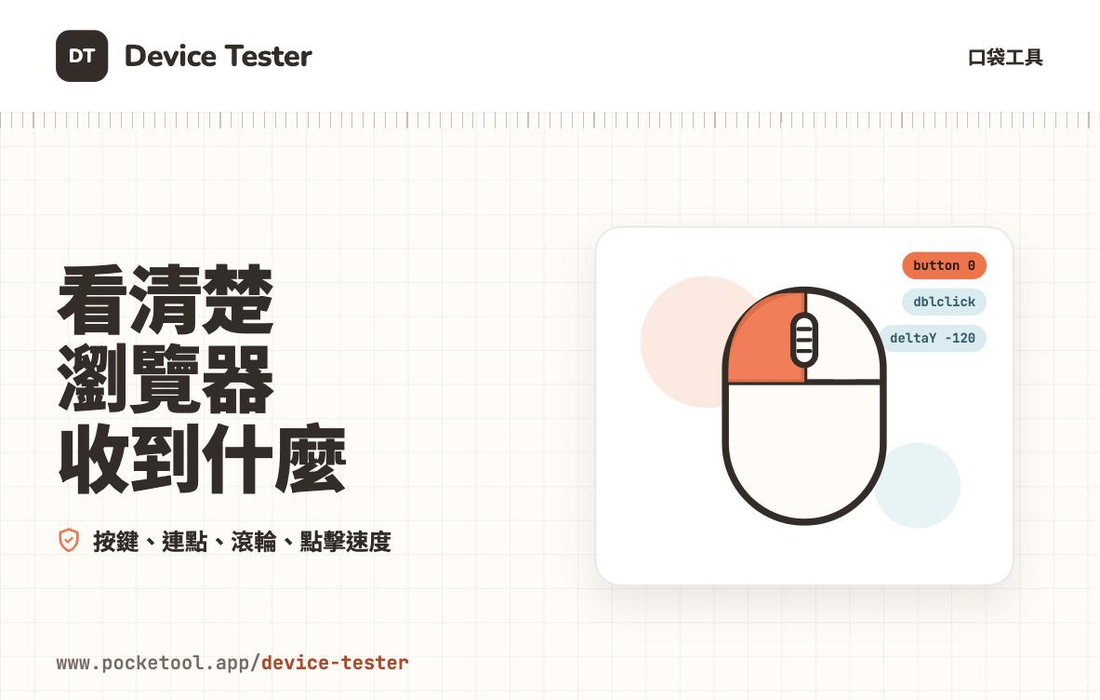 Tap the image to open the tool ↗
When a mouse starts misbehaving, the hard part is not the repair. It is working out which layer is at fault. One press registering as two could be a worn switch, or it could be the double click speed setting in your operating system. This tool lays out the events your browser actually receives, so you can rule out half the possibilities before you buy anything.
What this tool does
Four modes, no device permissions required, and nothing you do leaves the browser:
- Mouse Event Test: shows left, middle, right, Back and Forward, plus any other
buttoncode the browser reports, split into pressed, already tested and not detected, with a one click reset. Below that is a bounded list of recent events with their time,button,buttonsand click count. - Double-click Diagnostics: shows the interval in milliseconds between adjacent clicks and the spread of the last few, keeping the browser's native
dblclickevent separate from the interval it calculates itself. - Wheel Test: reports vertical and horizontal scroll direction along with the real
deltaX,deltaYanddeltaModevalues. - Click Speed: 1, 5, 10 and 30 seconds plus a custom duration, with a live count, time remaining and CPS, and a personal best kept per duration.
What it cannot do
Worth saying up front, so you do not misread the results.
The tool sees browser events, not hardware. A web page cannot read the state of a switch, a firmware version or a driver, so it cannot tell you a mouse is broken. What it can tell you is whether an action became an event, and how many.
In practice:
- A side button that does nothing is not necessarily faulty. Back and Forward are often intercepted by the browser or the operating system for history navigation and never reach the page at all. The tool marks that as a support limitation rather than a fault.
- No DPI, polling rate or latency figures. Event timestamps are affected by tab throttling, refresh rate and system scheduling, so deriving those numbers from them is unreliable. We would rather not print a number we cannot stand behind.
deltaYis not a count of wheel notches. Its unit depends ondeltaMode, and the conversion differs between browsers and operating systems, so it cannot be used to compare scroll sensitivity across machines.- No mouse results on a phone. Without a mouse attached, touch events are not mouse events. The tool says it is built for desktop or an external mouse rather than passing a tap off as a click.
Reading the double click results
One press registering as two is the classic mouse failure, but it has several causes. Work through them roughly in this order:
- Look at the interval first. Two deliberate human clicks are rarely closer than about 60 ms. If you pressed once and see a pair separated by something in the 10 to 40 ms range, that looks more like switch bounce at the hardware level.
- Check whether it is one button only. Usually the most used button, the left one, goes first. If both behave identically, suspect settings before hardware.
- Try another browser, then another computer. Same behaviour on two machines points at the mouse. Only on one machine, and the mouse settings and drivers on that machine are the better suspect.
- Check the operating system double click speed. Windows has it under mouse settings, macOS under System Settings, Mouse. It changes the threshold at which the system merges two clicks into one double click, but a web page cannot read that value, so the tool can only remind you to look.
The first version deliberately does not declare a pass or fail against a fixed millisecond threshold. It shows the numbers it observed. The same mouse produces very different figures in different hands, and drawing a single line through that would manufacture false alarms.
Reading clicks per second
CPS was always a number for comparing with other players, not a hardware specification.
- Shorter durations flatter you. A one second sprint produces a high score easily; the thirty second run is the one that shows consistency. If you are comparing with someone, compare the same duration.
- Records stay in your browser, stored per duration, and you can clear them. There is no leaderboard, no account and no anti cheat claim.
- The test area deliberately has no navigation or links around it, so a sprint does not end with a misclick onto another page.
Questions people ask
Does it record which buttons I pressed? Nothing is sent out. Raw button codes, coordinates, event intervals, wheel values and event history all stay in the browser. Analytics only receives a summary with no test content in it, such as the language and which mode started or finished.
Why does the page scroll when I press the middle button? Middle click triggers autoscroll by default in most browsers. The tool handles it inside the test area where it can, but behaviour differs between browsers. That is a browser level difference, not a mouse problem.
Will right click open the context menu? It is suppressed inside the test area so you can test the button, and left alone everywhere else, so it does not interfere with normal browsing.
Which browsers are supported? Chrome, Edge, Firefox and Safari. Ctrl-click on macOS, trackpads and horizontal wheels all behave differently across them; where they do, the tool marks the result as unsupported or not detected rather than reporting a hardware fault.
With the mouse checked, take a look at the other tools: QR Code Studio, Word and Character Counter, Pixel Smith ID Watermark, or go back to all tools.