
Kaomoji
Copy cute kaomoji and special characters in one tap
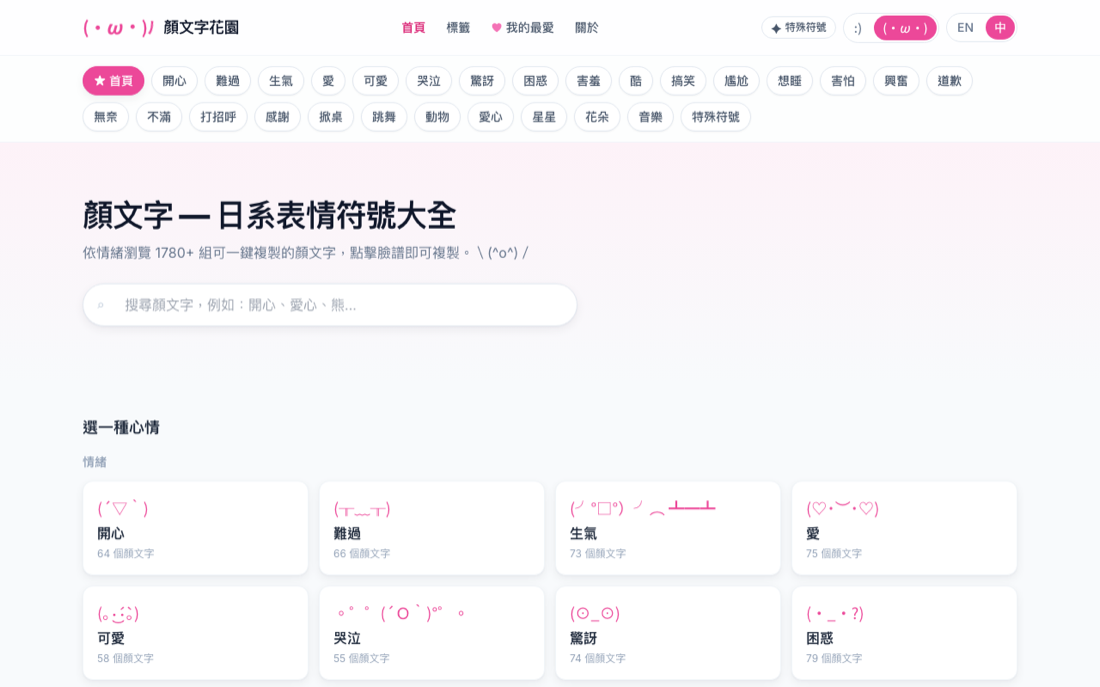 Tap the image to open the tool ↗
Kaomoji look like a bit of fun, and they are, but there is a real history behind them, from ASCII faces to the Japanese style faces you read straight on. There is also a practical side: why they sometimes turn into empty boxes on other people's screens. This page lets you copy them and explains both.
What this tool does
Kaomoji is a bilingual library of text faces and symbols, sorted into 28 categories by mood and theme, such as happy, angry, shy, crying, animals and cute. Tap one and it is copied to your clipboard right away, ready to paste into a chat, a post or a comment.
Alongside Japanese style faces like (。♥‿♥。), the site also collects:
- Western emoticons: sideways faces such as
:),xDand<3. - Special characters: arrows, stars, maths symbols and decorative frames that are awkward to type directly.
- Tags and favourites: browse by tag, and keep the ones you use often for next time.
Kaomoji, emoticons and emoji are not the same thing
The three words get mixed up constantly, but they are three different things:
| Name | Looks like | How you read it | What it really is |
|---|---|---|---|
| Emoticon | :-) | Tilt your head 90 degrees | Punctuation marks |
| Kaomoji | (´;ω;`) | Straight on, no tilting | Text characters arranged as a face |
| Emoji | 😀 | It is already a picture | Unicode pictographs |
The first emoticon is generally credited to Scott Fahlman, who suggested :-) on a Carnegie Mellon bulletin board in 1982 to mark jokes. Japanese internet culture, 2channel in particular, then developed faces you could read without tilting your head, and the wide range of characters available in Japanese text made the expressive faces we call kaomoji possible. Emoji came later, as coloured pictographs standardised by Unicode.
The advantage of kaomoji is that they are plain text and travel well. They paste into almost any input box and they look the same for everyone, instead of being redrawn by each platform.
How a kaomoji is put together
Once you can see the parts, you can adjust any face you find:
- Cheeks or frame:
( ),{ }and【 】wrap the face. - Eyes:
^ ^for a smile,T Tfor tears,o ofor surprise,> <for strain. - Mouth:
‿,ω,▽,Д. - Hands and motion:
╰( )╯,( ノ)and╮( )╭for a shrug give the face some movement.
Put smiling eyes with a ▽ mouth and raised arms together and you get ╰(*°▽°*)╯. Learn the pattern and you can express something specific without memorising a list.
Why they sometimes show up as boxes
A kaomoji is made of Unicode characters, so whether it renders depends on the fonts installed on the other person's device:
- Common face parts such as
^_^,ωand▽are very widely supported and show up almost everywhere. - Rarer maths symbols, box drawing characters and uncommon kana can fall back to an empty box on older systems or inside some apps.
- The practical rule: stick to common faces for chat, and for anything printed or on a sign, where a mistake is expensive, avoid the obscure characters.
Accessibility is worth a thought
Screen readers try to read symbols out one by one, so a long string of kaomoji can turn into a stream of brackets, tildes and commas for someone listening to it. A few habits help:
- Do not let a kaomoji carry information on its own. Say it in words as well.
- Keep the number of faces in one message low.
- Go easy in formal or public notices where accessibility matters.
How to use it
- Pick a mood or theme from the categories at the top.
- Browse that category and tap the face you want to copy it.
- Switch to any chat or text box and paste with Ctrl + V or Cmd + V.
Questions people ask
Will it turn into garbled text after I paste it? Kaomoji are standard text characters and render correctly anywhere Unicode is supported, which covers virtually every modern app. Only very old systems or environments missing fonts will show boxes instead of the rarer symbols.
Does it work on a phone? Yes. The site works in mobile browsers and tap to copy behaves the same way there.
Can I use these on Instagram, Threads or Discord? Yes. Because they are plain text, nearly every social and chat platform accepts them. Paste and send, with none of the restrictions that apply to sticker packs.
How is this different from typing an emoji? An emoji is drawn differently on each system, so the same smiling face does not look the same on iOS and Android. A kaomoji is plain text, everyone sees the same thing, and the faces can carry a more specific or playful tone.
Once you have your face copied, take a look at the other tools: QR Code Studio, Compound Interest Calculator, Taiwan ZIP Code Lookup, or go back to all tools.