
QR Code Studio
Design and download custom QR codes
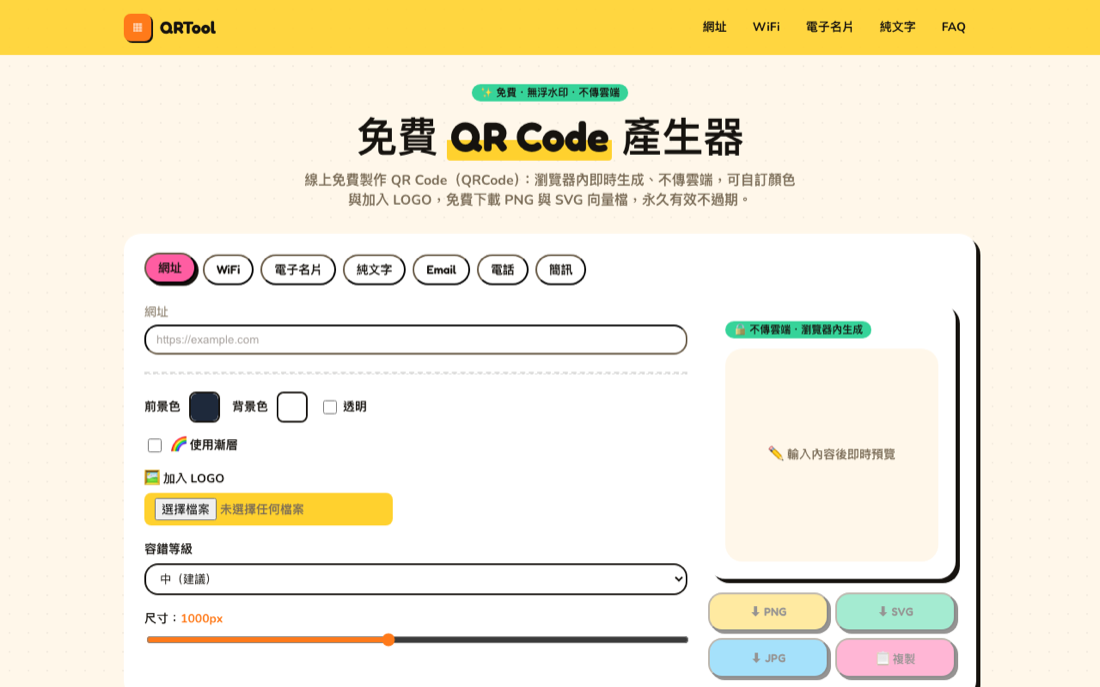 Tap the image to open the tool ↗
Making a QR code takes seconds. Making one that still scans after it has been printed, stuck on a wall and pointed at by twenty different phones takes a few decisions: which error correction level, how big a logo is safe, how much white space to leave. This page covers the tool and those details.
What this tool does
QR Code Studio is a free QR code generator that runs entirely in your browser and never uploads what you type, which matters when the code contains something private such as a WiFi password or your contact details. Supported types:
- URL: turn a web link into a code.
- WiFi: enter the network name and password so guests can scan and connect.
- vCard: put a name, phone number, email and company into a scannable contact card.
- Plain text, email, phone and SMS: the usual contact details in one step.
You can set the foreground and background colours, add a gradient, drop in a logo, choose the error correction level and the size, then download the result as PNG, SVG or JPG. SVG is vector, so it stays sharp at any size, which is what you want for posters and signage.
Need the striped barcode that goes on product packaging instead? QR Code Studio also has a barcode generator ↗ supporting Code 128, EAN-13, EAN-8, Code 39 and ITF-14, also generated in the browser, with PNG or SVG download.
Static and dynamic codes
This is the most common misunderstanding. This tool produces static QR codes. Here is the difference:
| Static QR code | Dynamic QR code | |
|---|---|---|
| Content | Encoded in the image itself | Image points at a redirect URL |
| Editable after printing | No | Yes |
| Can expire | No, it works forever | Depends on the provider, dead if the service stops |
| Scan analytics | None | Yes, counts and locations |
| Cost | Free | Usually a subscription |
For a fixed link, a WiFi network or a contact card, static is enough, it costs nothing and it does not depend on a company staying in business. You only need a dynamic service if you have to change the destination later or track how often the code is scanned.
Choosing an error correction level
QR codes carry redundant data, so they still scan when part of the image is dirty or covered. There are four levels:
| Level | Recoverable | Good for |
|---|---|---|
| L | About 7% | Clean environments, smallest possible code |
| M | About 15% | General use, the usual default |
| Q | About 25% | Printed material that may get scuffed |
| H | About 30% | Anything with a logo in the middle |
Higher correction means denser modules for the same physical size. M is fine on screen. For print, outdoor use or a logo, move up to Q or H.
Adding a logo without breaking the scan
A logo in the centre covers real data, and error correction is what puts it back. Three rules:
- Use level H, around 30%, so there is as much recovery capacity as possible.
- Keep the logo under about 25% to 30% of the area and centre it. Never cover the three large squares in the corners, since scanners use those to find the orientation of the code.
- Keep the contrast strong: dark modules on a light background, and do not let the logo blur into the modules around it.
Before printing a batch, scan the final file with more than one phone.
What each code type actually contains
- WiFi: behind the scenes it is a standard string,
WIFI:T:WPA;S:<network name>;P:<password>;;, which tells the phone which network to join. Good for a card on the counter so nobody has to read a password out loud. - vCard: name, phone, email and company packed into the contact format, so a scan offers to add you to the address book straight away.
- URL: the simplest one, a long link that opens with a scan.
Since WiFi passwords and personal contact details are private, the fact that everything is generated locally and never uploaded is the point.
Printing and design notes
- Leave the quiet zone: keep a clear margin around the code, roughly four modules wide. A code that runs to the edge of a design or sits inside a busy graphic often will not scan.
- Make it big enough: a useful rule of thumb is a scanning distance to code size ratio of about 10 to 1. To be scanned from one metre away, print it at least 10 centimetres wide.
- Print from SVG: vector stays crisp at any size, so posters and signs do not go soft.
- Keep contrast high: dark on light is the safe combination. Light modules on a dark background are inverted and many scanners will not read them.
How to use it
- Choose the code type: URL, WiFi, vCard and so on.
- Fill in the content.
- Adjust the colours, add a logo, set the error correction level and the size.
- Download PNG, SVG or JPG.
Questions people ask
Will the code expire? No. These are static QR codes. The content is encoded in the image, it works forever, and there is no scan limit.
Is anything recorded when someone scans it? No. The code is generated locally in your browser, what you type is never uploaded, and there is no tracking of who scans it.
Why is my QR code not scanning? The usual causes, in order: no quiet zone around the code, printed too small, not enough contrast because the colours are too light or inverted, a logo that is too large or overlapping a corner marker, or a blurry print. Work down the list and it is normally one of those.
Can I use rounded dots, colours and gradients? Yes, as long as contrast and error correction still hold up. The more decoration you add, the higher the correction level should be, and the more important it is to test the final file with a real phone.
With the code ready, take a look at the other tools: Kaomoji, Taiwan ZIP Code Lookup, Compound Interest Calculator, or go back to all tools.